

Our Projects
Every project starts with a question. How did this animal move? How should it be displayed? And how do we balance science, aesthetics and practicality?
Together with museums, scientists and private clients, we turn these questions into compelling reconstructions through research, preparation, restoration, 3D scanning and printing, and skeleton mounting.
Cera - the juvenile Triceratops
Wunderkammer · High‑resolution 3D scanning & 1:10 scale replicas

Through high‑resolution 3D scanning of the juvenile Triceratops skeleton, we generated two accurate, museum‑quality 1:10 scale replicas.
Services:
Client:
Completed:
High‑resolution 3D scanning, digital processing, 1:10 scale replica production
Wunderkammer
September 2025
The project
We received all 3D files from the museum, printed the components, assembled them and fully removed all print lines. We visited the museum to study the colours of the original bones, ensuring the new pieces matched the existing exhibition. All elements were hand‑painted and sealed. The Megalodon vertebrae consisted of a large series of 3D prints, each with unique colour patterns and mineral details. The painting process was intensive and entirely hand‑finished, resulting in no two vertebrae looking the same. For the Megaloceros skull, we engineered a system that allows the heavy antlers to be safely detachable, with an internal structure that distributes the weight evenly. The Mammuthus primigenius leg was finished in the same visual style so all elements integrate seamlessly within the travelling exhibition. Finally, we built custom transport crates and delivered the pieces to the museum, where they were fitted into the existing armatures.
Megalodon, Megaloceros & Mammoth — Travelling Giants
Institute of Natural Sciences Brussels · Vertebrae, Antlers & Limb Replicas
For the Travelling GIANTS exhibition, we produced and hand‑finished a large series of 3D‑printed Megalodon vertebrae, a Megaloceros skull with detachable antlers, and the leg of Mammuthus primigenius. Each element required a different technical approach, from detailed surface painting to structural engineering.
Services:
Client:
Completed:
Exhibition:
3D printing, finishing and painting
Institute of Natural Sciences Brussels
December 2024
GIANTS
The project
We received all 3D files from the museum, printed the components, assembled them and fully removed all print lines. We visited the museum to study the colours of the original bones, ensuring the new pieces matched the existing exhibition. All elements were hand‑painted and sealed. The Megalodon vertebrae consisted of a large series of 3D prints, each with unique colour patterns and mineral details. The painting process was intensive and entirely hand‑finished, resulting in no two vertebrae looking the same. For the Megaloceros skull, we engineered a system that allows the heavy antlers to be safely detachable, with an internal structure that distributes the weight evenly. The Mammuthus primigenius leg was finished in the same visual style so all elements integrate seamlessly within the travelling exhibition. Finally, we built custom transport crates and delivered the pieces to the museum, where they were fitted into the existing armatures.


Megatherium americanum - A Giant of the Past
Institute of Natural Sciences Brussels · Full skeleton mounting
For the travelling GIANTS exhibition by the Institute of Natural Sciences Brussels, we created a complete reconstruction of a Megatherium americanum skeleton.
Standing 2.60 metres tall, this prehistoric giant ground sloth is one of the highlights of the exhibition.
Services:
Client:
Completed:
Exhibition:
3D printing, finishing, painting, armature design and mounting
Institute of Natural Sciences Brussels
September 2024
GIANTS


The project
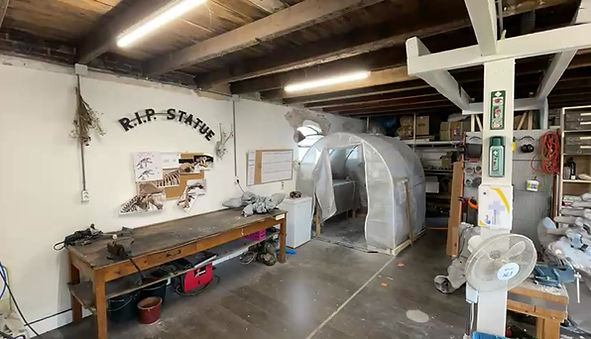
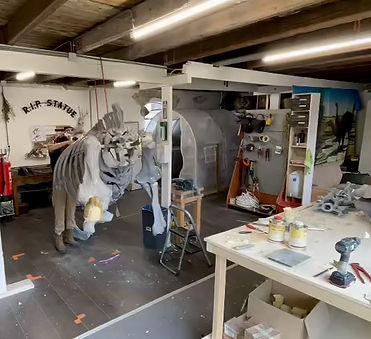
This skeleton was recreated using 3D printing. Each bone was carefully refined, textured and finished to resemble natural fossilised remains. We also designed and assembled a custom steel armature. Since the exhibition space did not allow the skeleton to stand fully upright, we developed a stable and dynamic reaching pose. The finished reconstruction combines a lifelike appearance with a strong and practical support structure. It is displayed as part of GIANTS, a travelling exhibition about the remarkable animals that lived after the extinction of most dinosaurs. Megatherium was a giant herbivore comparable in size to an elephant. It lived in South America during the Pleistocene and probably walked partly on its knuckles.
Cave Lion - Panthera Leo Spelaea
Institute of Natural Sciences Brussels · fossil mounting and pose reconstruction
For the travelling GIANTS exhibition, we created a custom steel armature for an original cave lion skeleton found in the Grottes de Goyet in Belgium.
Services:
Client:
Completed:
Exhibition:
Armature design, fossil mounting and pose reconstruction
Institute of Natural Sciences Brussels
October 2023
GIANTS

The project
Every bone required individual support while remaining detachable. The legs, head, spine and base were therefore designed as separate sections, allowing the skeleton to be transported, assembled and dismantled safely. We used 3D-printed copies during the metalworking process to protect the original bones. The historic mounting style was preserved, while the pose was made more dynamic using the modern lion as a reference. The completed armature was powder coated for a durable finish and now supports the original skeleton in the GIANTS exhibition. The cave lion lived during the Late Pleistocene. This specimen was discovered in Belgium and is more than 11,700 years old.


The Munich Show
Europe’s largest fossil and mineral fairs
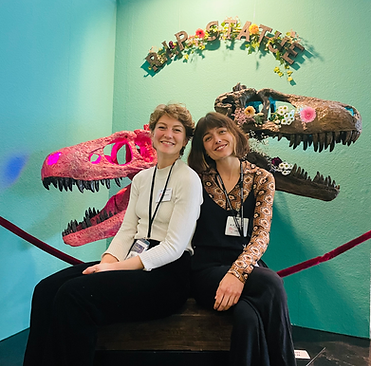
Shortly after the official launch of R.I.P. Statue, we presented our work at The Munich Show, one of Europe’s largest fossil and mineral fairs.
Focus:
Event:
Location:
Completed:
Exhibition stand, product presentation and networking
The Munich Show
Munich, Germany
October 2022


The Event
Across three large exhibition halls, thousands of visitors gathered to discover fossils, minerals and specialist craftsmanship. At our stand, we displayed our own products, shared our working methods and met collectors, professionals and fellow enthusiasts from the fossil community. The event gave us the opportunity to introduce R.I.P. Statue to an international audience and establish valuable new connections.
Night of Discoveries
Art & Science Festival · Live demonstration
Night of Discoveries was the first event where we presented R.I.P. Statue and our work to the public.
Focus:
Event:
Location:
Completed:
Live demonstration, skull presentation and public engagement
Night of Discoveries
Leiden, the Netherlands
September 2022
The Event
Our completed Daspletosaurus skulls formed the centrepiece of the stand. Alongside the finished replicas, we displayed a mould and demonstrated preparation work live to show visitors how a reconstruction is created. The event took place across Leiden University, the Hortus Botanicus, the Academy Building and the Old Observatory. The festival allowed us to share both the finished work and the creative process behind it with a broad audience of young scientists, artists and curious visitors.


Daspletosaurus Skull - Skull reconstruction
hand modelling· mould making· casting

The Daspletosaurus skull was the project that led to the creation of R.I.P. Statue.
Services:
Client:
Completed:
Skull reconstruction, hand modelling, mould making and casting
R.I.P. Statue
May 2021
The project
The project began with a request for a Tyrannosaurus rex skull. This developed into a collaboration to create a detailed replica of a Daspletosaurus skull. After months of research and hand modelling, the form and details were completed. A silicone mould was then created, allowing us to produce accurate reproductions and develop creative variations of the original design. The final skull was entirely modelled and finished by hand. It became the starting point for R.I.P. Statue and continues to represent the craftsmanship and creativity behind our work. Daspletosaurus was a large tyrannosaurid predator that lived around 77 million years ago. Its name means “formidable lizard”, and adults could reach lengths of approximately nine metres.


Triceratops - Skull No. 21
Delft University of Technology · Scientific restoration
Triceratops Skull No. 21 was scientifically restored after suffering extensive damage during its long history.
Services:
Client:
Completed:
Scientific restoration of the Skull
Delft University of Technology
August 2020
The project
The skull was discovered in Wyoming in 1891 and arrived at Delft University of Technology around 1950. It had previously been damaged during transport and repaired using the limited techniques available at the time. During the new restoration, modern technologies such as 3D scanning, CT scanning and 3D printing were combined with specialist knowledge and traditional craftsmanship. The restoration revealed important original details, including exceptionally well-preserved teeth, while returning the skull to a scientifically accurate and presentable condition. Triceratops lived during the Late Cretaceous and was one of the last non-avian dinosaur species. It is recognised by its three horns and large neck frill.


Brachiosaurus - giraffatitan
Sauriermuseum Aathal, Switzerland · Skeleton restoration
This large Brachiosaurus skeleton was originally modelled and built by Aart Walen in 1992 for the Sauriermuseum Aathal.
Services:
Client:
Completed:
Skeleton restoration, repair and visual updating
Sauriermuseum Aathal, Switzerland
March 2020
The project
After almost thirty years on display, the skeleton required repairs and a visual update. Aart and Lina worked together to restore damaged sections and refresh the overall appearance while preserving the original reconstruction. The restored skeleton remains on display at the museum and continues to be one of its most recognisable exhibits. Brachiosaurus was a large, long-necked herbivore. Its name means “arm lizard”, referring to its unusually long front limbs. The reconstruction was based on the famous Brachiosaurus specimen displayed in Berlin.


Betasuchus - The Dutch T-rex
Het Nationaal Oertijdmuseum · Full skeleton mounting
Betasuchus is one of the few dinosaurs known from fossil remains discovered in the Netherlands.
Services:
Client:
Completed:
Full skeleton reconstruction
Het Nationaal Oertijdmuseum
August 2018


The project
Only part of the right femur of Betasuchus is known, making a complete reconstruction especially challenging. To develop the skeleton, related tyrannosaur material was studied, including remains of Bagaraatan from Mongolia. These references formed the basis for much of the reconstructed anatomy. The completed skeleton was produced using 3D printing and carefully finished to create a convincing and lifelike reconstruction. The full process was documented in From Bone to Beast – The Quest for the Dutch T-Rex. Betasuchus was a relatively small predatory dinosaur and is considered particularly important because dinosaur remains are rarely discovered in the Netherlands.
Sperm Whale - wangerooge
Nationalpark-Haus Wangerooge, Germany · fossil mounting
In 2016, several young sperm whales became stranded along the coasts of north-western Europe. Two of them washed ashore on the German island of Wangerooge.
Carcass processing, skeleton preparation, cleaning and mounting
Nationalpark-Haus Wangerooge, Germany
2017 April
Services:
Client:
Completed:


The project
Aart Walen helped process the stranded animals using his experience in taxidermy and specimen preparation. One of the skeletons was then cleaned, prepared and mounted for permanent exhibition on Wangerooge. The mounted skeleton gives visitors the rare opportunity to view the anatomy of a sperm whale at close range. It also serves an important educational role by increasing understanding of marine life and conservation. The preparation process was documented in From Whale to Skeleton.